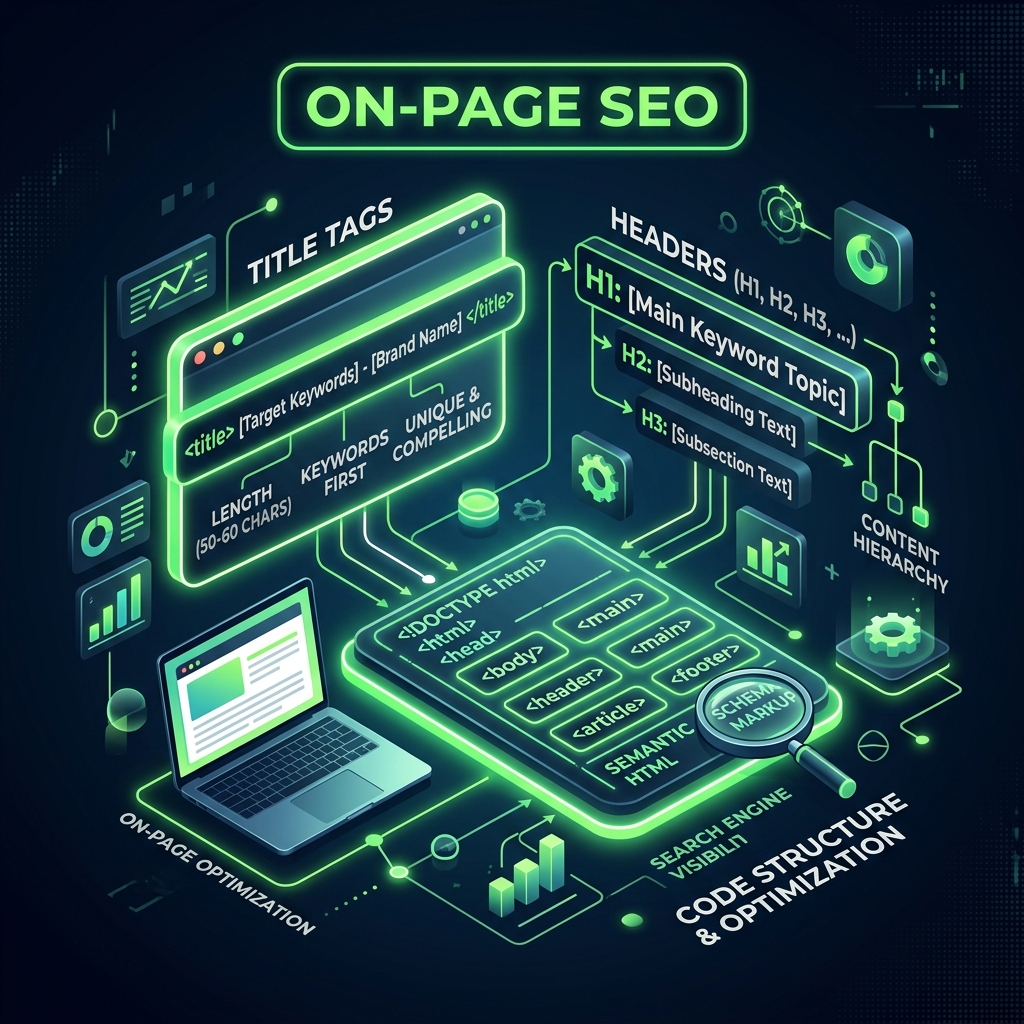
What is On-Page SEO and Why It Is Not Just "Changing the Title"
On-page SEO is a set of optimizations inside the page itself: structure, content, meta tags, images, speed.
According to Ahrefs, an optimized page converts 40% more traffic.
1. Title and Meta Description: First Clicks in SERP
It is the only thing Google does not fully control—but you can make it attractive.
The ideal title formula:
Keyword | Brand
Examples:
- Buy a mattress in NY - from $150 | SleepWell
- Turnkey apartment renovation in London | BuildMaster
- SEO for e-commerce - 150% growth | IndexFast
Place the keyword in the first 60 characters. Google truncates the title after 600px.
Meta description — page flyer
160 characters. Highlight benefits, not keywords. Add a CTA: "order", "download", "learn more".
2. H1-H6: Semantic Hierarchy for People and Bots
Google uses headings to understand content structure. Rules:
- H1 — one per page. Page topic. Contains the main keyword.
- H2 — sections. First-level subheadings.
- H3-H6 — subsections. Do not overload: 2-3 levels are enough.
- Do not skip levels: H1 → H2 → H3, not H1 → H4.
3. Content Optimization: TF-IDF, LSI, and Nothing Extra
In 2026, Google evaluates topical completeness rather than keyword density.
How to check:
- Surfer SEO / NeuronWriter — compare top 10 competitors.
- LSI keywords — synonyms and related terms.
- TF-IDF — term frequency. 1.5-2.5% is enough.
4. Internal Linking: Pass Power Between Pages
Internal links help Google understand site architecture.
- Anchor = context. Instead of "here" use a descriptive anchor.
- Hypertext in the first paragraph.
- 3-5 internal links per 1500+ words page.
- "Read Also" module at the end of the article.
5. Images: alt, WebP, lazy load
Images make up to 60% of page weight. Optimization:
- Alt-text — describe the image.
- WebP/AVIF format.
- Lazy loading.
- Responsive images.
- File name — descriptive names.
6. Core Web Vitals: UX = Rank
Google confirmed: Core Web Vitals is a ranking factor.
- LCP < 2.5s.
- INP < 200ms.
- CLS < 0.1.
How to improve: lazy load, minimize JS/CSS, use CDN.
7. Schema.org: Rich Snippets
Structured data increases CTR by 15-30%.
Required for:
- Product — price, availability, rating.
- Article — for blog posts.
- FAQPage — for FAQ sections.
- LocalBusiness.
- BreadcrumbList.
Want Google to quickly index your pages?
IndexFast automates indexing via the Google Indexing API.
Start for free →8. On-Page SEO Checklist
- ✅ Title < 60 chars, contains keyword
- ✅ Meta description < 160 chars
- ✅ One H1
- ✅ H2/H3 structure
- ✅ First 100 words have keyword
- ✅ Alt-tags for images
- ✅ Internal links (3+)
- ✅ Canonical URL
- ✅ Open Graph tags
- ✅ Load speed < 3s
- ✅ Mobile friendly
- ✅ Schema.org markup
9. Common Mistakes That Destroy Rank
- Keyword in title, but not in H1.
- Duplicate title/description.
- Too long "SEO" content. Write useful content.
- Ignoring featured snippets.
- Not checking Google Search Console.
Conclusion
On-page SEO is a continuous process. Create pages for people. Use IndexFast to quickly index them.